Motor & Cylinder Technology in Tire Inflators: A B2B Buyer’s Complete Guide

You depend on motor and cylinder technology for tire inflators that deliver precision, reliability, and efficiency. When you source a portable tire inflator, you protect vehicle safety during emergency situations and maintain optimal tire pressure. Tire inflator guide resources help you compare suppliers, evaluate inflation performance, and check pressure accuracy. B2B sourcing air compressors, especially for tire inflator wholesale, demands careful attention to reliability, accuracy, and how to select a tire inflator. You need high-quality car tyre inflator pump suppliers who meet standards for pressure accuracy, portability, and emergency response. Top-tier portable car pump suppliers and reliable car tyre inflator pump suppliers support your tire inflator guide and how to inflate car tires. Sourcing air compressors and tire inflators is a strategic guide for b2b buyers who focus on sourcing air compressors, tire inflation, and air compressor for car tires.
You encounter challenges in sourcing air compressors, comparing tire inflators, and verifying supplier quality. Use this tire inflator guide to ensure you select the right tire inflator for accuracy, reliability, and emergency situations.
Key Takeaways
Understand motor and cylinder technology to choose reliable tire inflators. This knowledge ensures you select models that meet your operational needs and enhance vehicle safety.
Evaluate suppliers based on performance, durability, and compliance with industry standards. This step helps you avoid costly recalls and ensures reliable tire inflation for your fleet.
Focus on pressure accuracy and inflation speed when sourcing inflators. These factors reduce downtime and improve emergency response, supporting efficient tire maintenance.
Key Concepts in Tire Inflator Technology
Motor and Cylinder Basics
You rely on the motor and cylinder as the core components of every tire inflator. The motor powers the piston, which moves inside the cylinder to compress air. This process transforms the inflator into a miniature air compressor, driving air into the tire for proper inflation. The motor connects to gears that pull the piston down to draw air in, then push it up to pump air out. This cycle ensures consistent tire pressure and supports safe vehicle operation. When you compare inflators, you notice differences in airflow, power source, and durability. The table below highlights how motor and cylinder technologies vary between standard car inflators and pro-grade models:
Feature | Standard Car Inflator | Pro-Grade Off-Road/Tubeless Inflator |
|---|---|---|
Airflow (CFM) | Low (1-2 CFM) | High (5.0+ CFM) |
Power Source | Cigarette Lighter | Direct Battery Connection |
Bead Seating | No | Yes (with tank/high-flow design) |
Deflation | Manual / Slow | Integrated, Rapid Deflator |
Duty Cycle | Short | Long |
Durability (IP Rating) | Low / None | High (Often IP54 or better) |
Piston and Cylinder Arrangement
You encounter two main piston and cylinder arrangements in tire inflators: vertical and horizontal. Each design affects performance and maintenance. Vertical compressors fit tight spaces and make oil drainage easier during shutdown. Horizontal compressors provide better cooling and suit high-output industrial tire inflation. The table below compares these arrangements:
Arrangement Type | Advantages | Disadvantages |
|---|---|---|
Vertical | Maintenance advantages, oil drainage, compact design | Requires proper foundation, potential stability issues |
Horizontal | Easier maintenance, better cooling, higher horsepower | Larger footprint, may require more space |
Vertical compressors work well for limited space and maintenance needs.
Horizontal compressors deliver better cooling and higher power for demanding tire inflation tasks.
Why It Matters for B2B Buyers
You must understand motor and cylinder technology when sourcing tire inflators for your business. This knowledge helps you select inflators that deliver reliable tire inflation and meet your operational demands. You evaluate suppliers based on product performance, durability, and compatibility with your tire service needs. When you choose the right tire inflator, you improve customer satisfaction and meet market expectations. You also reduce downtime and maintenance costs, which supports your business growth.
Tip: When you assess tire inflators, focus on motor and cylinder design to ensure long-term reliability and efficient tire inflation for your fleet or service center.
Types of Motors in Tire Inflators
DC and AC Motors
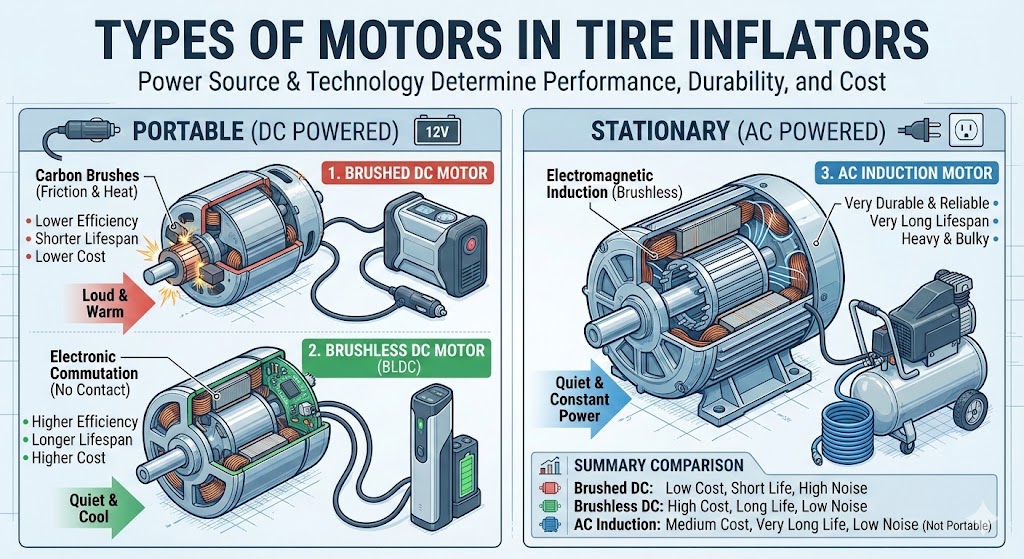
When you select a tire inflator for your business, you must understand the differences between DC and AC motors. DC motors power most portable tire inflator models. You benefit from simple installation and fast response times. These motors deliver high startup power and torque, which helps you inflate tires quickly. AC motors offer high durability and longer life spans. You see these motors in heavy-duty inflators for industrial tire applications. AC motors also provide controllable starting current levels and support multi-phase configurations. However, AC motors require more complex control systems and deliver less torque at low speeds. The table below summarizes the main advantages and disadvantages:
Motor Type | Advantages | Disadvantages |
|---|---|---|
AC Motors | Low startup power demands, controllable starting current, high durability, multi-phase options | More complex control systems, less torque at low speeds |
DC Motors | Simple installation, high startup power and torque, fast response | Shorter lifespan, more maintenance required |
Brushed vs. Brushless Motors
You encounter two main motor types in inflators: brushed and brushless. Brushed motors use physical brushes and commutators. These motors require regular maintenance and have a shorter operating life, usually between 1,000 and 8,000 hours. Brushless motors use electronic controllers. You gain longer operating life, often between 10,000 and 100,000 hours, and minimal maintenance needs. Brushless motors rarely need repairs, except for electronic inspections. The table below highlights lifespan and maintenance differences:
Motor Type | Lifespan (Years) | Maintenance Requirements |
|---|---|---|
Brushless Motors | 7 - 10 | Minimal; no brushes to replace |
Brushed Motors | 2 - 3 | Frequent brush replacement and cleaning required |
Tip: For fleet operations or high-volume tire service, you should choose inflators with brushless motors to reduce downtime and maintenance costs.
You improve tire inflator reliability and efficiency by understanding motor types. This knowledge helps you select inflators that match your tire service needs.
Cylinder Technologies in Inflators
Single vs. Dual Cylinder
You face a choice between single and dual cylinder designs when selecting inflators for your business. Single cylinder inflators suit standard family cars and light-duty applications. These models offer reliable performance for everyday tire maintenance. Dual cylinder inflators deliver higher inflation capacity and faster inflation times. Two pistons operate together, doubling air displacement and increasing CFM. This design reduces motor strain and extends the duty cycle, making dual cylinder inflators ideal for commercial use and larger vehicles. You benefit from smoother operation and less downtime. Dual cylinder inflators work well for trucks, vans, and off-road vehicles that require greater tire inflation volume.
Dual cylinder inflators move more air, resulting in faster inflation.
The simultaneous piston action increases efficiency and reduces wear.
You experience longer duty cycles and improved durability with dual cylinder models.
Feature | Description |
|---|---|
Cylinder Type | Double-cylinder, providing larger inflation volume compared to single-cylinder inflators. |
Inflation Speed | Faster inflation reduces waiting time, making it ideal for commercial use. |
Application | Suitable for inflating large vehicles such as trucks and vans. |
Product Variants | Includes models with anti-vibration design and portable options with battery clamps. |
Materials and Build Quality
You must evaluate the materials and build quality of inflators to ensure long-term reliability. High-grade metals such as aluminum and stainless steel resist corrosion and withstand repeated use. Premium seals and gaskets prevent air leaks and maintain consistent tire pressure. Anti-vibration features protect internal components and extend the lifespan of your tire inflator. You should look for inflators with reinforced housings and robust connectors. These features help your inflators perform well in demanding environments and reduce maintenance costs. Quality construction supports safe and efficient tire inflation for your fleet or service center.
Tip: Choose inflators with durable materials and advanced cylinder designs to maximize performance and minimize downtime.
Performance Metrics for B2B Tire Inflators
Inflation Speed and Pressure
You need to evaluate inflation speed and pressure when sourcing tire inflators for your b2b operations. Fast inflation reduces downtime and supports emergency response. Leading commercial inflators deliver maximum pressure outputs between 145 PSI and 150 PSI. For example, the ACARLUOY Portable model inflates from 29 PSI to 36 PSI in just one minute. This speed is critical for fleet maintenance and roadside emergency situations. You should compare tire inflator models using the following table:
Tire Inflator | Maximum Pressure Output | Inflation Speed |
|---|---|---|
PNT PRO | 145 PSI | N/A |
ACARLUOY Portable | 150 PSI | 29 PSI to 36 PSI in 1 min |
You must also consider pressure accuracy. Top suppliers design inflators to meet ±1 PSI tolerance per EN 12099 standards. This level of accuracy ensures safe tire inflation and reduces the risk of under- or over-inflation. You protect your vehicles and maintain compliance with industry standards.
Pressure accuracy: ±1 PSI tolerance per EN 12099 standards
Durability: Minimum 5,000 inflation cycles without performance drop
Thermal safety: Overheat protection activation at safe thresholds
Environmental resilience: IP65 or higher rating for dust and water resistance
Heat Management and Motor Lifespan
You encounter heat management challenges during high-volume tire inflation. Motors generate heat as they run, especially during emergency use or when inflating multiple tires. Overheating can cause shutdowns and damage internal components. You need inflators with advanced heat dissipation systems and overheat protection. These features extend motor lifespan and improve reliability.
A user shared their experience:
"Tried to top off my RV tires before a trip. The rear tires needed to go from 95 to 110 PSI. My ‘heavy-duty’ inflator ran for 15 minutes straight just to add 5 PSI to one tire, got incredibly hot, and then shut off. Had to wait 30 minutes for it to cool down. It’s useless."
You should check the duty cycle of each air compressor for car tires. A low duty cycle, such as 25%, means the inflator can only run for a short time before needing to cool down. This limitation makes it impractical for filling multiple large tires during emergency situations. You improve operational efficiency by choosing inflators with higher duty cycles and robust heat management.
The inflator's overheating is linked to its duty cycle, which is the percentage of time it can operate before needing a rest.
A low duty cycle (e.g., 25%) means it can only run for a short time before cooling down, making it impractical for filling multiple large tires.
Reliability and Maintenance
You depend on reliability and low maintenance for your b2b tire inflator fleet. Frequent breakdowns increase costs and disrupt emergency services. You should select inflators that meet strict durability standards, such as a minimum of 5,000 inflation cycles without performance drop. You also need to verify that your suppliers offer models with reinforced housings and premium seals.
You can compare supplier performance using the following table:
Supplier | Review Score | Response Time | On-Time Delivery | Online Revenue | Reorder Rate | Staff Size | Years Active | Factory Area |
|---|---|---|---|---|---|---|---|---|
Shenzhen Smartnewo Technology Co., Ltd. | 4.8/5.0 | ≤2h | 100.0% | $750,000+ | <15% | 200+ | 7 yrs | 7,100+ m² |
GZ Jolly Flying Ltd. | 4.9/5.0 | ≤1h | 98.1% | $190,000+ | <15% | 50+ | 4 yrs | 1,000+ m² |
Yuyao Liuyang Appliances Of Autocar Co., Ltd. | 4.3/5.0 | ≤2h | 97.2% | $2,400,000+ | 25% | 110+ | 8 yrs | 8,700+ m² |
Shenzhen Taiworld Technology Co., Ltd. | 4.8/5.0 | ≤2h | 96.4% | $360,000+ | 34% | 250+ | 7 yrs | 47,000+ m² |
Shenzhen Hengyejia Technology Co., Limited | 4.7/5.0 | ≤4h | 98.7% | $730,000+ | <15% | 10+ | 11 yrs | N/A |
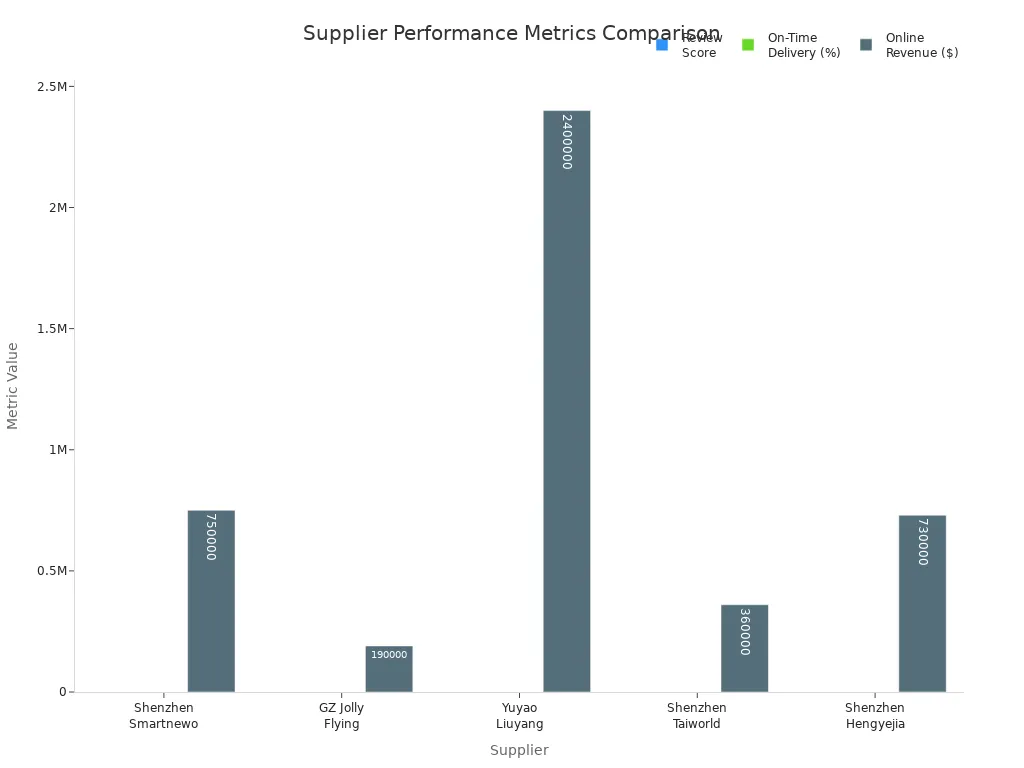
You should choose suppliers with high review scores, fast response times, and strong on-time delivery rates. These metrics reflect reliability and support for your b2b needs. You also need to confirm that your tire inflators comply with CE Marking, RoHS, EMC, and UL standards. These certifications allow you to access Western markets and guarantee safety for your air compressor for car tires.
Tip: Regularly inspect your inflators for wear, leaks, and overheating. Schedule preventive maintenance to extend service life and reduce emergency downtime.
Evaluating Tire Inflator Quality and Standards
Technical Specifications
You must review technical specifications before you select inflators for your business. These details reveal how well the inflators will perform during emergency situations and daily tire maintenance. Focus on pressure accuracy, cycle durability, and battery performance. Pressure accuracy ensures safe tire inflation and reduces the risk of under- or over-inflation. Cycle durability shows how many times the inflators can operate without failure. Battery performance affects how long you can use the air compressor for car tires in the field.
Certification | Region | Purpose |
|---|---|---|
CE (EMC/LVD) | EU | Electromagnetic compatibility and electrical safety |
FCC | USA | Radiation and signal interference compliance |
RoHS | Global | Restriction of hazardous substances |
IPX4 | Global | Water resistance for outdoor use |
E-mark | EU | Automotive component approval |
Tip: Always request detailed technical sheets from your suppliers to compare tire inflator models side by side.
Industry Certifications
You should only consider inflators that meet recognized industry certifications. These certifications guarantee reliability and safety for your air compressor for car tires. Look for ISO 9001, which confirms that the supplier follows strict quality assurance processes. ASTM standards ensure that the inflators comply with automotive and chemical safety requirements. Suppliers who provide certified tire inflators help you avoid costly recalls and support your emergency response operations.
ISO 9001: Quality management and assurance
ASTM Standards: Automotive and chemical safety compliance
Testing Protocols
You need to verify that your suppliers use rigorous testing protocols. Reliable suppliers test inflators for pressure accuracy, cycle durability, and battery performance. They also check for water resistance and electrical safety. Ask your supplier about their testing methods and request test reports. This step helps you confirm that the air compressor for car tires will perform well during emergency tire inflation. You reduce the risk of failure and improve your fleet’s reliability.
Note: Consistent testing and certification protect your business from emergency downtime and ensure safe tire inflation for every vehicle.
Common B2B Pain Points and Solutions
Downtime and Reliability Issues
You face downtime and reliability challenges when managing inflators for commercial operations. The most frequent causes include underinflation, overloading, road hazards, and worn-out tires. These issues can weaken tire structure and lead to unexpected blowouts. Review the table below to understand the main factors affecting reliability:
Cause | Description |
|---|---|
Underinflation | Insufficient air pressure leads to excess friction and heat, weakening the tire's structure. |
Overloading | Exceeding load capacity increases stress on tires, causing potential sidewall failure. |
Road Hazards | Sharp debris and potholes can damage tires, leading to delayed blowouts from previously weakened tires. |
Worn-Out Tires | Aging tires with degraded rubber compounds are more prone to blowouts, especially under heavy loads. |
Regular inspection and preventive maintenance of inflators help you minimize downtime and extend service life.
Compatibility and Integration
You encounter compatibility and integration challenges when adopting new inflators for your fleet. Seamless connectivity with existing systems is crucial. Varying technological standards across devices complicate integration. Compatibility with hardware and software systems ensures effective implementation. Reliance on Bluetooth and Wi-Fi can limit functionality in certain environments.
Manufacturers invest in R&D for faster pairing times and reliable connections.
Advanced app features, such as real-time diagnostics, enhance user experience.
Integration with voice assistants improves usability.
Choose inflators that support your fleet management systems and offer flexible connectivity options.
Supply Chain and Sourcing Challenges
You often struggle with sourcing reliable inflators for different tire types. Inconsistent tire sizes and pressure requirements complicate product selection. Many inflators take too long to inflate tires, which frustrates customers and affects service turnaround times. Bulky or heavy models create portability issues for on-site services.
Sourcing reliable products remains a top priority.
Inefficiencies in inflation times impact operational efficiency.
Portability issues hinder on-site service capabilities.
Evaluate suppliers carefully to ensure you receive inflators that meet your sourcing needs and support efficient tire maintenance.
Tire Inflator Wholesale Sourcing Guide
Defining Business Needs
You start the tire inflator wholesale process by defining your business needs. You identify the types of inflators required for your fleet, service center, or retail operation. You consider the volume of tire inflation tasks, the range of tire sizes, and the frequency of emergency situations. You assess whether you need portable inflators for roadside assistance or heavy-duty models for industrial use. You set clear performance benchmarks for inflation speed, pressure accuracy, and durability. You also determine your budget and preferred delivery timelines.
List your operational requirements for tire inflators.
Specify the minimum technical standards for each inflator.
Estimate the quantity needed for tire inflator wholesale orders.
Identify any special features, such as rapid inflation or advanced heat management.
Consider regulatory requirements for emergency use and safety compliance.
Tip: You improve sourcing efficiency by documenting your needs before contacting suppliers. This step helps you communicate expectations and avoid costly mismatches.
Comparing Wholesale Suppliers
You compare b2b suppliers using a structured approach. You evaluate each supplier’s compliance, production standards, technical capabilities, scalability, and support infrastructure. You request product samples and review technical sheets for tire inflators. You check for certifications such as ISO 9001, CE, and DOT to ensure quality and safety. You ask for third-party audits to verify manufacturing processes. You assess the supplier’s ability to scale with your business and review their historical delivery performance. You also examine warranty terms, spare parts availability, and customer support options.
Criteria | Description |
|---|---|
Compliance and Certification | Look for suppliers with ISO 9001, CE, and DOT certifications to ensure quality and safety. |
Production Audit and Inspection | Request third-party audits to verify manufacturing standards and quality control processes. |
Technical Performance Specifications | Ensure suppliers meet minimum technical benchmarks for nitrogen purity and flow rates. |
Scalability and Operational Metrics | Assess the supplier's ability to grow with your business and their historical delivery performance. |
After-Sales Support Infrastructure | Evaluate warranty terms, availability of spare parts, and customer support options. |
You use this table to compare tire inflator wholesale suppliers side by side. You prioritize suppliers who demonstrate strong compliance, reliable production, and robust support. You also review customer feedback and case studies to gauge supplier reputation.
Request detailed technical documentation for inflators.
Verify certifications and audit reports.
Assess scalability for future tire inflator wholesale growth.
Review after-sales support and emergency response capabilities.
Note: You reduce risk by choosing suppliers with proven track records and comprehensive support systems.
Negotiating Price and Support
You approach negotiations with a clear strategy. You leverage market knowledge to anticipate changes and adapt your tactics. You prevent suppliers from taking advantage of you by staying informed about pricing trends and competitor offerings. You build long-term relationships with suppliers, which encourages them to offer competitive pricing and better support. You include multi-year commitments and conduct quarterly reviews to foster partnership. You time your negotiations strategically, such as during off-peak seasons or at quarter-end, to capitalize on supplier urgency.
Strategy | Why | How | Impact |
|---|---|---|---|
Build Long-Term Relationships | Suppliers are more likely to offer competitive pricing when they see long-term potential. | Include multi-year commitments, conduct quarterly reviews, treat suppliers as partners. | Suppliers become strategic allies, helping you grow and solve problems. |
Time Your Negotiations Strategically | Timing can significantly impact negotiation outcomes. | Negotiate during off-peak seasons, use quarter-end urgency. | Capitalize on moments of opportunity and avoid rushed negotiations. |
Negotiate for Value, Not Just Price | Focusing only on price can lead to missed opportunities. | Ask for added services, negotiate flexible payment terms. | Walk away with a more comprehensive deal that supports strategic goals. |
You negotiate for value, not just price. You ask for added services, such as extended warranties or flexible payment terms. You ensure suppliers understand your expectations by communicating needs clearly. You foster trust and transparency through regular communication, which improves negotiation outcomes and collaboration.
Build strong relationships with suppliers to foster trust.
Communicate needs and expectations clearly.
Negotiate for comprehensive support, not just lower prices.
Use market insights to strengthen your position.
Tip: You secure better deals and long-term support by treating suppliers as strategic partners in your tire inflator wholesale sourcing process.
Step-by-Step Approach for B2B Tire Inflator Wholesale Sourcing
Define your business needs and technical requirements for inflators.
Research and shortlist b2b suppliers with proven expertise in tire inflator wholesale.
Request product samples and technical documentation for evaluation.
Compare suppliers using compliance, production, scalability, and support criteria.
Verify certifications and audit reports for quality assurance.
Negotiate pricing, support, and added value based on market knowledge.
Finalize agreements with clear terms for delivery, warranty, and emergency support.
Monitor supplier performance through regular reviews and feedback.
You streamline your tire inflator wholesale sourcing by following these steps. You ensure reliable supply, optimal pricing, and strong support for your b2b operations.
Comparing Tire Inflator Technologies and Suppliers
Technology Strengths and Weaknesses
You need to evaluate the strengths and weaknesses of different inflators before making a b2b sourcing decision. Each technology offers unique benefits and limitations that impact your tire service operations. Consider these factors when comparing tire inflator options:
Inflation speed varies across inflators, affecting how quickly you can service multiple tires in high-volume b2b environments.
Weight influences portability. Lighter inflators suit mobile tire service teams, while heavier models may provide greater durability for stationary use.
Noise level matters in noise-sensitive settings. Quiet inflators help you maintain a professional atmosphere in retail or fleet service locations.
Power source type determines flexibility. Electric, battery, manual, and pneumatic inflators each fit different b2b sourcing needs.
Material quality affects long-term performance and cost-effectiveness. Durable inflators reduce replacement frequency and lower total sourcing costs.
You can use the following table to compare key features:
Feature | Benefit for B2B Sourcing | Limitation for B2B Sourcing |
|---|---|---|
Inflation Speed | Faster tire service turnaround | May increase cost |
Weight | Easier transport for mobile teams | Heavier models less portable |
Noise Level | Suitable for quiet environments | Loud inflators limit placement |
Power Source | Flexible deployment options | Some sources limit runtime |
Material Quality | Longer lifespan, fewer repairs | Premium materials cost more |
Supplier Reputation and Track Record
You must assess supplier reputation and track record when sourcing tire inflators for your b2b operations. Reliable suppliers consistently deliver inflators that meet your tire service standards. Look for these qualities:
Accurate pressure measurement ensures safe and effective tire inflation.
Consistent pressure maintenance supports long-term tire health.
Fast inflation speed improves operational efficiency for b2b sourcing.
Portability and convenience allow you to deploy inflators across multiple service locations.
Durability and reliability reduce downtime and maintenance costs.
Tip: Always review supplier performance history and customer feedback before finalizing your b2b sourcing agreements. Strong supplier reputation leads to better tire inflator reliability and long-term value for your business.
Pricing and Market Trends in Tire Inflators
Price Drivers and Cost Analysis
You see several factors shaping the cost of a tire inflator in today’s market. These drivers influence your sourcing decisions and impact your bottom line.
Technological advancements add new features and improve efficiency, which often raises the price of inflators.
Raw material costs, such as metals and plastics, directly affect production expenses for suppliers.
Supply chain dynamics, including logistics and component availability, create pricing complexities for every supplier.
Regulatory impacts, like tariffs and import duties, increase production costs for tire inflators.
Stricter safety standards and emissions regulations push manufacturers to innovate, which can lead to higher prices.
Economic growth in emerging markets boosts demand for tire inflators, affecting global pricing.
Currency fluctuations change import and export costs for both suppliers and buyers.
You should analyze these factors when you compare inflators from different suppliers. This approach helps you understand price variations and negotiate better deals for your business.
Emerging Tech and Future Outlook
You will notice rapid changes in the tire inflator market over the next five years. The demand for advanced inflators continues to rise, driven by smart device integration, IoT connectivity, and eco-friendly designs. These trends reshape how you approach inflation solutions and influence your procurement strategies. Recent advancements in AI and sensor technology improve the precision and user experience of inflators. These features matter for fleet operators and OEMs who need reliable tire inflation and real-time data. Smart inflators now offer Bluetooth connectivity and real-time pressure monitoring, making them essential for modern fleet management and electric vehicle support. You gain more control, accuracy, and efficiency by adopting these innovations from leading suppliers.
Tip: Stay updated on emerging technologies to maintain a competitive edge and ensure your tire service operations remain future-ready.
You drive business success by choosing the right tire inflator with advanced motor and cylinder technology. Evaluate inflators and suppliers carefully to meet your tire service needs. For long-term value, follow these steps:
Verify supplier compliance and certifications.
Request product samples and factory audits.
Review warranty and after-sales support.
Leverage this guide to make smarter tire inflator procurement decisions.
FAQ
What certifications should you check before buying tire inflators?
You should look for CE, ISO 9001, and RoHS certifications. These guarantee safety, quality, and compliance with international standards.
How often should you perform maintenance on tire inflators?
You should inspect inflators monthly. Clean filters, check seals, and test pressure accuracy to ensure reliable performance.
Can you use the same inflator for cars, trucks, and bikes?
You can use multi-purpose inflators. Always check the pressure range and nozzle compatibility for each vehicle type.
See Also
Essential Features B2B Buyers Seek in Today's Tire Inflators
Key Insights for B2B Buyers on Wholesale Tire Inflators
Tailored Tire Inflators: OEM and ODM Options for Distributors
Finding the Right Balance of Quality and Price for Bulk Tire Inflators
Assessing Tire Inflator Manufacturers: Key Tips for Quality and Certification