Wholesale Tire Inflators: What B2B Buyers Need to Know Before Importing

As a b2b buyer, you must assess every detail before importing tire inflators. Supplier reliability shapes your business reputation, while product quality affects customer satisfaction. Compliance with local and international standards protects your investment and avoids legal issues. Shipping logistics can impact your delivery timelines and costs.
Pay close attention to documentation and trade regulations when selecting a tire inflator supplier to prevent costly mistakes.
Key Takeaways
Prioritize supplier reliability and product quality to enhance your business reputation and customer satisfaction.
Ensure compliance with local and international regulations to avoid legal issues and shipment delays.
Request detailed specifications and performance test reports from suppliers to confirm product capabilities.
Prepare all essential import documents accurately to prevent costly customs delays and fines.
Build strong relationships with suppliers for better pricing, support, and reliable deliveries.
Tire Inflator Quality Standards

Key Features for B2B Buyers
When you evaluate tire inflators for your business, you must focus on features that directly impact operational efficiency and customer satisfaction. B2B buyers often request specific capabilities that streamline fleet management and reduce downtime. The following table highlights the most sought-after features in commercial tire inflators:
Feature | Description |
|---|---|
Performance Benchmarks | Target inflation cycles under 5 minutes for standard car tires. Premium models sustain 30+ minutes continuous operation. |
Integration Capabilities | Confirm compatibility with fleet management software via Bluetooth 5.0+. |
After-Sales Support | Providers with 24/7 technical support and local spare parts inventories minimize operational downtime. |
Customization Options | Validate OEM customization options for branding in high-volume procurement. |
You should prioritize performance benchmarks and integration capabilities when selecting tire inflator suppliers. Fast inflation cycles and continuous operation help your team maintain productivity. Reliable after-sales support ensures you resolve issues quickly, while customization options allow you to strengthen your brand presence.
Tip: Always request detailed specifications from your supplier before placing a bulk order. This step helps you avoid mismatches between your operational needs and the product’s actual capabilities.
Material and Durability
Material selection plays a critical role in the durability and reliability of tire inflators. High-quality commercial models use robust materials that withstand frequent use and harsh environments. The table below outlines the most common materials found in premium tire inflators:
Material Type | Description |
|---|---|
Metal | Provides durability and strength. |
High-quality plastic | Offers lightweight and ruggedness. |
Metal components deliver superior durability, making them ideal for heavy-duty applications. High-quality plastic reduces weight without sacrificing ruggedness, which benefits mobile service teams. You should inspect product samples and request material certifications from your supplier to confirm quality standards.
Note: Durable materials extend the lifespan of your equipment and reduce replacement costs over time.
Performance Testing
You must verify the performance of tire inflators before committing to large-scale imports. Performance testing ensures each unit meets your operational requirements and maintains consistent quality. Leading tire inflator suppliers conduct rigorous tests, including:
Cycle time measurement for standard tire inflation
Continuous operation stress tests
Leak and pressure retention checks
Environmental resistance assessments
You can request performance test reports and certifications from your supplier. These documents provide evidence of reliability and help you avoid costly returns or warranty claims. Consistent performance across batches signals a supplier’s commitment to quality and supports your business reputation.
Callout: Reliable performance testing protects your investment and builds trust with your customers.
Compliance and Import Documentation
International and Local Regulations
You must understand both international and local regulations before importing tire inflators. Each country sets its own rules for customs clearance, product safety, and labeling. If you ignore these requirements, you risk shipment delays, fines, or even confiscation. Customs authorities often check for compliance with safety standards and environmental guidelines. Some regions require special permits or licenses for certain types of inflators. You should always research the destination country’s import laws and consult with a customs broker if you feel unsure.
Tip: Stay updated on regulatory changes in your target markets. Regulations can change quickly, and missing a new rule can disrupt your supply chain.
Essential Import Documents
Proper documentation forms the backbone of a smooth import process. Missing or incorrect paperwork can halt your shipment at the border. As a b2b buyer, you need to prepare several key documents for customs clearance. The table below outlines the most important documents you will need when importing tire inflators into major markets:
Document Type | Description |
|---|---|
Commercial Invoice | Details the transaction, including specifications, quantity, and value of the tire inflators. |
Packing List | Lists the contents, weight, and dimensions of the shipment. |
Bill of Lading / Air Waybill | Serves as a contract of carriage and proof of shipment. |
Certificate of Origin | Verifies the country of manufacture for the tire inflators. |
CBP Form 3461/7501 | Required for customs release in certain cases. |
Tariffs and Duties | Import duties for tire inflators, typically ranging from 2-6%, based on HS code and customs value. |
Mistakes in documentation often cause the most common import delays. You can avoid these issues by double-checking every detail before shipping. Here are the top errors that lead to problems at customs:
Incorrect HS Codes: A single incorrect digit can alter duty rates or result in non-compliance.
Incomplete or Inaccurate Invoices: Missing details can trigger customs queries and lead to fines.
Vague Cargo Descriptions: Generic terms can cause inspections and clearance delays.
Missing Permits or Certificates: Certain goods need special licenses; missing documents can hold shipments.
Incorrect Incoterms or Valuation: Wrongly applied Incoterms can lead to disputes and unexpected costs.
Ignoring Country-Specific Regulations: Customs laws differ by country, and violations can occur if not followed.
Note: Always review your documents with your supplier before shipment. This step helps you catch errors early and prevents costly delays.
Certification Requirements
You must secure the right certifications to clear customs and sell tire inflators in your target market. Many countries require proof that your products meet safety, environmental, and quality standards. For example, you may need CE marking for Europe, FCC certification for the United States, or CCC certification for China. These certifications show that your tire inflators comply with local laws and industry standards.
You should request copies of all relevant certifications from your supplier before finalizing your order. Keep these documents on file, as customs officials may ask for them during clearance. If you plan to sell in multiple markets, check if you need additional certifications for each region.
Callout: Proper certification protects your business from legal risks and builds trust with your customers.
Choosing Tire Inflator Suppliers
Supplier Verification for B2B
You need to verify tire inflator suppliers before making any commitment. Effective supplier verification helps you avoid costly mistakes and ensures you work with reputable partners. You can use several methods to confirm a supplier’s claims and capabilities:
Check compliance and certifications through third-party audits or regulatory databases.
Analyze competitor data, including product performance and customer reviews.
Review growth forecasts and research investments to gauge future readiness.
Test product claims with pilot programs or proof-of-concept trials.
Use data analytics tools to compare total cost of ownership and maintenance needs.
Consult industry experts or review consulting reports for validation.
Tip: Always request documentation and independent test results before finalizing your supplier selection.
Assessing Reliability and Delivery
You must assess the reliability and delivery performance of each supplier. Reliable delivery keeps your business running smoothly and prevents supply chain disruptions. The table below outlines key criteria you should consider when evaluating tire inflator suppliers:
Criteria | Description |
|---|---|
Production Capabilities | Look for manufacturers with quality control processes such as ISO certifications. |
Compliance | Confirm adherence to international standards like DOT, ECE, or INMETRO for your target markets. |
Reliability Metrics | Review on-time delivery rates (aim for over 95%), response times, and reorder rates. |
Quality Verification | Request third-party lab testing, factory audit reports, and customer reviews. |
Scalability | Make sure production capacity matches your order volumes and growth plans. |
Note: Reliable suppliers help you avoid delays and maintain consistent product quality.
Communication and Support
Clear communication with your supplier is essential for successful b2b transactions. You should establish direct contact channels and set expectations for response times. Good communication helps you resolve issues quickly and ensures you receive accurate updates about your orders. You can also ask about after-sales support, warranty policies, and technical assistance. Strong support from tire inflator suppliers builds trust and helps you manage unexpected challenges.
Callout: Open communication and responsive support are key to building long-term supplier relationships.
Shipping and Cost Factors for B2B Buyers
Shipping Methods and Incoterms
You need to choose the right shipping method and Incoterm to control costs and manage risk during procurement. Each option shifts responsibility and expenses between you and your supplier. Common Incoterms include:
EXW (Ex Works): You pick up goods from the supplier’s location. This method can raise costs if you do not manage logistics well.
FOB (Free On Board): The supplier loads goods onto the ship. You take on risk and insurance after loading.
CIF (Cost, Insurance, Freight): The supplier pays for transport and insurance. This approach can simplify budgeting but may lead to higher initial pricing.
DDP (Delivered Duty Paid): The supplier handles all shipping and duties. You face less risk, but the total cost may increase.
You should discuss these terms with air pump suppliers to find the best fit for your sourcing strategy.
Tariffs and Trade Regulations
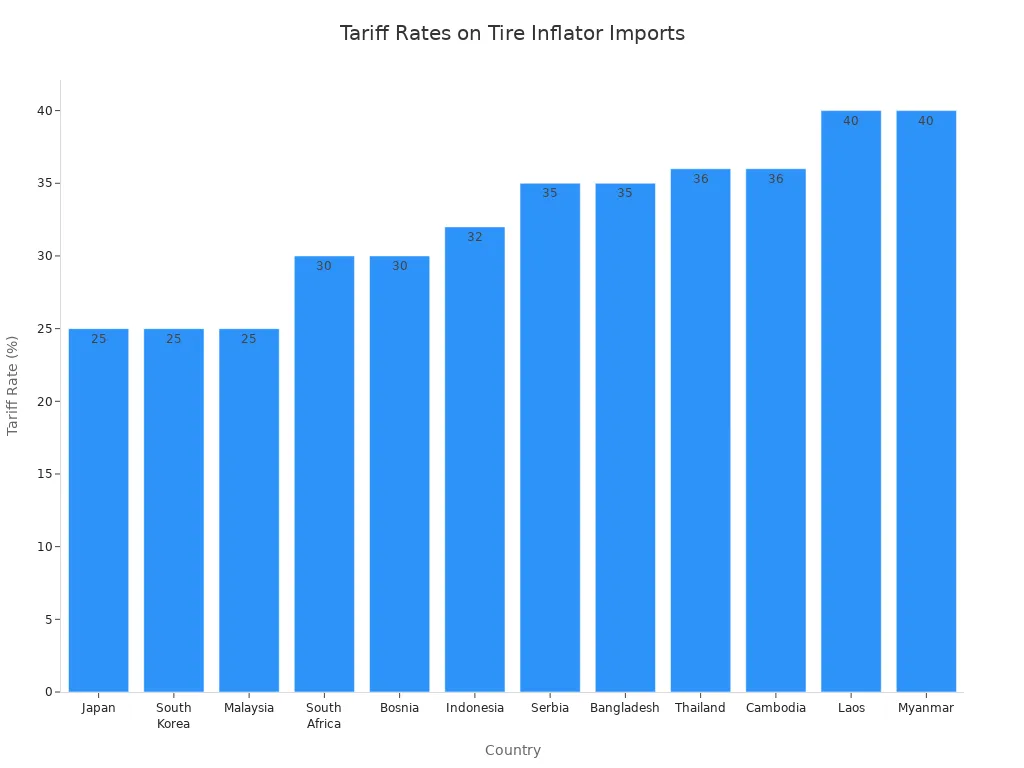
Tariffs and trade regulations can impact your landed cost and supply chain value. Some countries apply high tariff rates on tire inflators, which can disrupt logistics and affect your bottom line. Review the table below to see how tariffs vary by country:
Country | Tariff Rate | Impact on Supply Chain |
|---|---|---|
Japan | 25% | Increased costs for importing tires, affecting B2B buyers. |
South Korea | 25% | Similar cost increases, impacting competitiveness. |
Malaysia | 25% | Disruption in supply chains for tire inflators. |
South Africa | 30% | Higher import costs affecting B2B transactions. |
Bosnia | 30% | Increased prices for tire inflators. |
Indonesia | 32% | Potential supply chain disruptions. |
Serbia | 35% | Increased costs for B2B buyers. |
Bangladesh | 35% | Higher tariffs leading to increased prices. |
Thailand | 36% | Impact on supply chain logistics. |
Cambodia | 36% | Increased costs for B2B buyers. |
Laos | 40% | Significant impact on import costs. |
Myanmar | 40% | Disruption in supply chains for tire inflators. |
You should work with air pump wholesalers who understand local regulations to avoid unexpected fees.
Calculating Total Cost
You must calculate the total landed cost before finalizing any procurement. This cost includes more than just the product price. Consider these factors:
Shipping fees and insurance
Handling and port fees
Bank wire transfer charges
Customs bond for imports over $2,500
Prep fees or 3PL receiving if not shipping direct
Inspection fees for regulated goods
Accurate cost calculation helps you compare suppliers and make informed decisions. You can protect your business by reviewing all charges and managing shipping risks with reliable logistics partners. This approach ensures you get the best performance and value from your air pump suppliers.
Tip: Always request a detailed cost breakdown from your supplier to avoid hidden expenses.
Common Import Challenges for B2B
Quality Control Issues
You face several quality control issues when importing tire inflators. These problems can affect your business reputation and customer satisfaction. Many defects arise from poor manufacturing practices or inadequate inspection. You should always request factory audits before placing large orders. The following table highlights common defects and their impact on performance:
Defect Type | Description | Potential Causes | Impact on Performance |
|---|---|---|---|
Uneven Wear | Irregular wear pattern | Incorrect inflation pressure, poor alignment | Reduced traction and tire life |
Blistering/Buckling | Separation of tire layers | Impact damage, underinflation, overloading | Tire failure, safety hazard |
Cracking | Small cracks in sidewall or tread | Age, UV exposure, chemicals, underinflation | Shorter tire life, risk of punctures |
Separation | Tread separates from tire body | Manufacturing defects, overloading, underinflation | Tire failure, loss of control |
Impact Breaks | Internal damage from road hazards | Potholes, curbs, sharp objects | Weakened structure, risk of blowouts |
Tip: Inspect product samples and review test reports to confirm consistent quality before shipment.
Delays and Hidden Costs
Importing tire inflators often brings unexpected delays and hidden costs. Customs clearance can take longer than planned if documents are incomplete or incorrect. Shipping schedules may change due to weather or port congestion. You might also face extra fees for storage, handling, or inspections. These costs add up quickly and can hurt your profit margins.
Double-check all paperwork before shipping.
Work with logistics partners who provide transparent pricing.
Track shipments and prepare for possible delays.
Note: Planning for extra time and budget helps you avoid surprises and keeps your supply chain running smoothly.
Handling Returns and Warranty
Managing returns and warranty claims is a challenge for many buyers. You need clear agreements with suppliers about return policies and warranty coverage. Some suppliers offer limited support, which can make it hard to resolve issues. You should ask for written warranty terms and understand the process for handling defective products.
Request warranty documentation before finalizing your order.
Set up a process for inspecting returned items.
Communicate with suppliers about replacement or repair options.
Callout: Strong warranty support and clear return procedures protect your investment and build trust with your customers.
Tips for Successful B2B Importing
Building Supplier Relationships
You can strengthen your business by building long-term relationships with your tire inflator suppliers. Strong partnerships help you manage risks and improve supplier reliability. Consider these strategies to create lasting connections:
Practice vendor diversification. Source from multiple suppliers to reduce the risk of disruptions.
Set strong contract terms. Include clear details to protect your business from supplier failures.
Focus on supplier relationship management. Treat your suppliers as strategic partners and encourage open communication.
Conduct regular risk assessments and audits. Evaluate your suppliers’ capabilities and identify potential issues early.
Invest in visibility. Use supply chain monitoring tools to spot problems before they grow.
Keep strategic inventory buffers. Maintain extra stock to avoid production delays.
Leverage a postponement strategy. Delay product customization so you can adapt quickly if supply changes.
Tip: Building trust with your suppliers leads to better pricing, faster support, and more reliable deliveries.
Import Checklist for B2B Buyers
A detailed checklist helps you avoid mistakes during the import process. Use this list to keep your tire inflator shipments on track:
Confirm supplier selection and verify credentials.
Review all contracts and payment terms.
Check product certifications and compliance documents.
Prepare commercial invoices, packing lists, and shipping documents.
Arrange insurance and select the best shipping method.
Track shipments and monitor delivery schedules.
Plan for customs clearance and pay duties on time.
Note: A checklist keeps your import process organized and reduces the risk of costly errors.
Using Third-Party Inspections
Third-party inspections give you an extra layer of quality control. Inspectors check your tire inflators before shipment and report any defects. You can use their findings to approve or reject batches. This step protects your business from receiving faulty products and helps maintain your reputation.
Callout: Independent inspections support supplier reliability and ensure you meet your quality standards.
Staying Updated on Market Trends
You need to stay informed about changes in the tire inflator market. Watch for new technologies, shifts in demand, and updates to trade regulations. Join industry groups, attend trade shows, and subscribe to market reports. Staying current helps you adjust your sourcing strategy and stay ahead of competitors.
Tip: Regular market research supports smarter decisions and keeps your business competitive.
You must focus on supplier reliability, product quality, compliance, and shipping when importing tire inflators. Careful research and complete documentation help you avoid costly mistakes. Use the tips in this guide to streamline your import process.
Review supplier credentials
Check certifications
Calculate total costs
Tip: Reach out to trusted tire inflator suppliers or consult import experts to ensure a smooth experience.
FAQ
What certifications do you need for importing tire inflators?
You need certifications like CE for Europe, FCC for the United States, or CCC for China. Always request these documents from your supplier before shipping.
Tip: Check local regulations for additional certification requirements.
How do you verify a tire inflator supplier’s reliability?
You should review supplier credentials, request third-party audit reports, and check customer reviews.
Ask for proof of ISO certification
Request recent delivery records
What documents must you prepare for customs clearance?
Prepare a commercial invoice, packing list, bill of lading, and certificate of origin.
Document | Purpose |
|---|---|
Commercial Invoice | Transaction details |
Packing List | Shipment contents |
Bill of Lading | Proof of shipment |
Certificate of Origin | Country of manufacture |
How can you avoid hidden costs when importing tire inflators?
You should request a detailed cost breakdown from your supplier.
Note: Review shipping fees, tariffs, insurance, and handling charges before finalizing your order.
See Also
Choosing Between Direct Factories And Exporters For Car Accessories
Exploring Wholesale Markets For In-Demand Car Electronics Today
Rising Demand For Tire Inflators Boosts Car Accessory Sales
Understanding Seasonal Trends In Tire Inflator Sales Demand
Maximizing Profit Margins By Selling Tire Inflators In Stores